
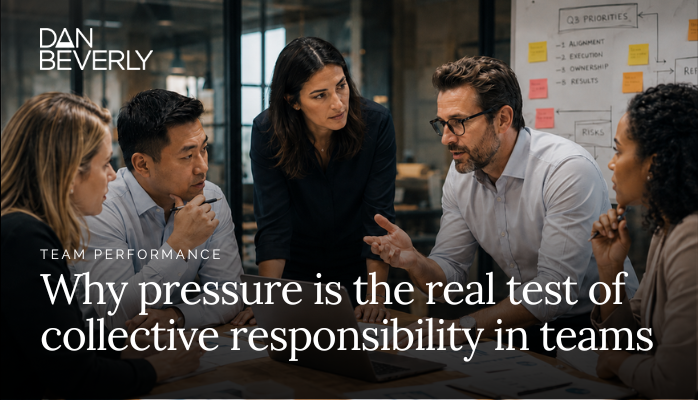
Why Pressure is the Real Test of Collective Responsibility in Teams

Over the next few weeks, I’m working with an outstanding scientific team on the finer points of exceptional teamworking and performance. One of the core concepts we’ll be exploring in today’s session is how pressure can impact a team’s collective capacity for interpersonal risk-taking.
Why does this matter?
Because when deadlines tighten and expectations rise, team members become more dependent on colleagues, and more exposed to results they cannot control or deliver alone. In such moments, highly capable and cohesive teams can retreat into the relative safety of group behaviour. And although a largely non-conscious shift, it’s not without consequence:
- responsibility flows solely to the leader
- local priorities take precedence
- decisions become provisional
- peer issues triangulate
Common responses call for greater alignment, accountability and collaboration. Those may help and we’ll talk about those today, too. But without understanding the root cause, we risk changing surface behaviour whilst leaving deeper dynamics unaddressed.
The problem is not intellectual.
It’s the perceived interpersonal risk of teaming:
- depending on peers for your success
- revealing where your area is struggling
- challenging decisions across boundaries
- accepting challenge from colleagues
- sharing responsibility for results
Under pressure, the benefits of interdependence can quickly be outweighed by the need to protect autonomy, reputation and control. Group behaviour satisfies those needs and feels rational to the individual. But collectively, every choice to reduce personal exposure weakens the team.
The antidote is to raise collective awareness and responsibility by surfacing the patterns, making the risks discussable and strengthening the collective response to pressure. And that’s what we’ll be doing today, working together to develop a stronger set of collective habits, in response to the pressure:
- sharing difficult information earlier
- offering challenge across boundaries
- making trade-offs before priorities collide
- holding to decisions and commitments
- resolving issues peer to peer
The test of a team is not how collaborative it appears when conditions are comfortable. The test is what happens to collective responsibility when the pressure mounts.
In those moments, there is significant opportunity for the team that can learn to stay collective as the interpersonal stakes rise.
…
I help leadership, management and delivery teams build collective awareness and responsibility for the patterns that disrupt alignment and potential.
If your team is becoming less connected, candid and mutually accountable as a result of growing pressure, learn how team coaching can help.
Thanks for reading
I really appreciate your readership. If you’d like to receive new articles, direct to your inbox as they become available, you can subscribe here.