
The Real Reason Managers Avoid Difficult Conversations

I find there is a widespread assumption among many leaders that the reason their managers avoid difficult conversations is because they don’t know they should be having them and they don’t know how.
The thought then becomes: make it clear that this is their responsibility. Give them a model. Give them instruction on the model. And the conversations will follow.
You don’t need me to tell you this is rarely a winning formula.
Your managers know they should be giving feedback. They know they should be addressing the performance issue that’s been quietly accumulating for 3 months. They know they should sit down with their most capable team member and have an honest conversation about what’s next. Yet they don’t.
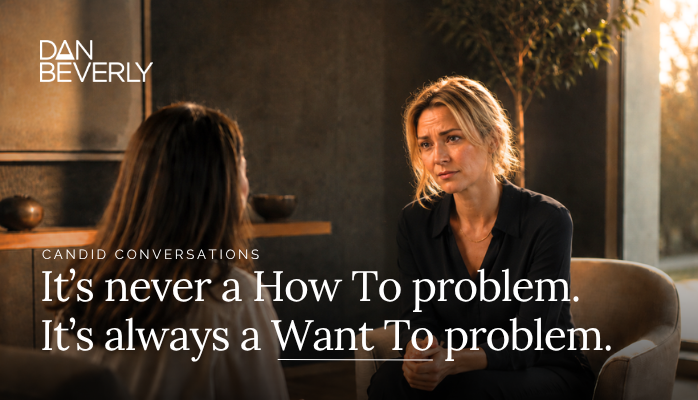
I’ve been a coach for 15 years. Let me tell you: it’s never a Knowing problem, nor a How To problem. It’s always a Want To problem.
And that resistance is considerably more difficult to train away.
The anxiety of an anticipated reaction. The worry of managing defensiveness and upset. The fear of damaging a relationship. The uncertainty about how to hold a standard firmly without it feeling like a personal attack.
These are relationally complex, emotionally charged situations. And in the face of such challenge, a framework is of little comfort and limited application. What’s needed is a profound shift in how managers understand their role and their relationship to the discomfort that will inevitably arise in the moments that matter.
The gap for managers between knowing there’s a conversation to have and actually having the conversation – in ways that are candid, constructive and stretching – is the gap my coaching work with managers is designed to close.
Not by adding to what managers know, but by developing the coaching mindset, the conversational skill and the emotional capacity that makes the difficult conversations not only possible, but habitual.
What would change in your organisation if your managers closed that gap?
Not just occasionally, but as a matter of habit.
And what is the cost that they haven’t yet?
If you’d like to explore what closing that gap could look like for your organisation, you can find out more about my Brain-based Coaching Manager programme here.
Thanks for reading
I really appreciate your readership. If you’d like to receive new articles, direct to your inbox as they become available, you can subscribe here.